
How to Search the Leesburg Court Docket
Begin with the exact court name printed on the citation, hearing notice, or clerk letter. A ticket issued into Leesburg Municipal Court stays with the city. Nothing moves it unless the record shows a transfer. The city's official calendar can spot public Municipal Court events by date and category. It offers no citation-number or party-name field, though. Keep your citation number close. It gives Clerk Debra Perry the best key for pulling the city record when the calendar alone is not enough.
- Read the citation for the court, date, and citation number.
- Open the city calendar and choose Court Calendar.
- Set a narrow start and end date.
- Compare the event with the official notice.
- Call 229-759-6465 to confirm the setting.
- Use the named county clerk if the paper identifies a county court.
An empty calendar result proves nothing. The interface publishes events only, not a complete register of parties and filings. Before you search another system, ask the issuing office which clerk received the citation.
Leesburg Court Docket Calendar Filters
The calendar's controls include Start Date, End Date, search terms, Show Past Events, Select a Calendar, and month or year navigation. Pick Court Calendar instead of searching every city event. A narrow date window keeps court sessions separate from meetings. Search terms can trim the event list, but the city provides no public citation-number field. The official Leesburg calendar displays these controls for any docket search.
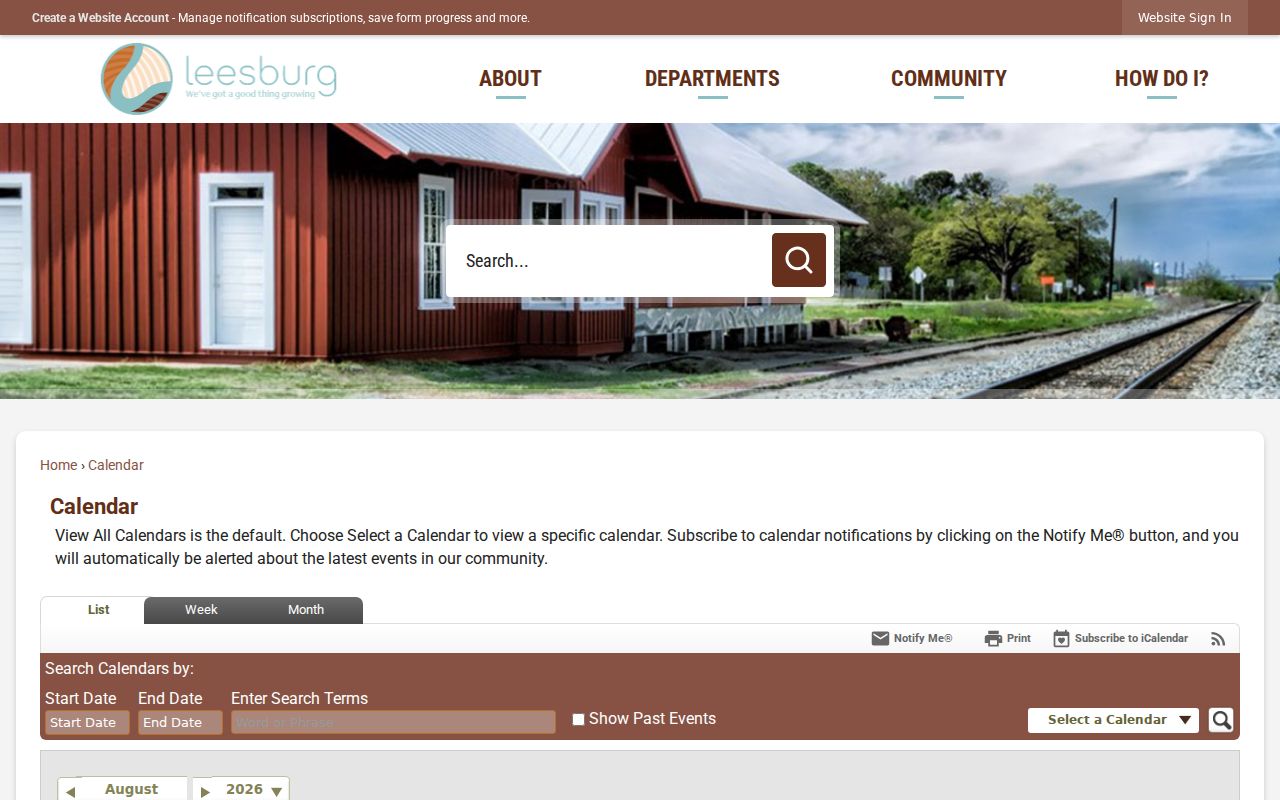
Two access layers are at work here. The public calendar locates a Municipal Court event, while the clerk ties that event to a citation and its current status.
The Leesburg Municipal Court Docket
Leesburg Municipal Court sits at 107 Walnut Avenue North, PO Box 890, Leesburg, GA 31763. Its official contact page names Judge Gregory Williams and Clerk Debra Perry. The phone is 229-759-6465, and the fax is 229-759-6249. The city publishes no separate court-office hours. So the clerk and the calendar are your sound sources for a current setting.
This court handles city traffic and ordinance matters. A felony, major civil action, divorce, or other general-jurisdiction case never becomes a municipal case. Geography alone does not change that. Nor does a city calendar event reveal filings held by Sara Clark, Clerk of Superior Court.
At the city counter, ask for the citation docket or event history. Give the exact number and date. A certified copy? Ask what record is available and what current fee applies. The city posts no full local copy-fee schedule.
Leesburg Citation Docket Deadline
For a non-mandatory charge, Leesburg requires payment by 4:00 p.m. on the day before court. Paying is not a neutral hold. The city states that an online payment enters a Nolo or Guilty plea. Anyone who wants to plead Not Guilty must appear in person. Do not use that path.
Before paying: Check whether appearance is required and read the plea effect. Payment may close off a trial request or possible driving-safety or deferred-disposition route.
Fines vary by charge, and a card service fee may apply. Use the ticket number or call for the current total. A receipt proves payment; the court record confirms the disposition entered on the docket.
Leesburg Court Dates and Settings
One sample public Municipal Court event listed a 9:00 a.m. session held in the back of City Hall. That event does not fix every citation date. Read the newest notice and call whenever a reset, continuance, or conflicting date appears, since an old event can stay visible after a later one controls.
| Date | Event date checked against the citation and later notices. |
|---|---|
| Time | Session time, which may be a shared docket call. |
| Location | Published room or place within City Hall. |
| Judge | Judge Gregory Williams is named by the city. |
| Setting Type | Arraignment, trial, compliance, or the notice's label. |
A setting is not a result. A reset just moves an event. Find the judgment, disposition, or clerk confirmation before treating any Leesburg matter as finished.
Leesburg Docket Continuance Rules
The municipal FAQ says the court office may allow one continuance for an arraignment date. The request must come at least 48 hours before court. The new date lands on the officer's next arraignment date. That is not a promise each request will be granted. Not Guilty and trial settings require appearance. The court may also reset them on its own.
Call before the deadline and ask how the new date will appear. A request alone never moves a court date. Clerk confirmation or a fresh notice is the useful proof. If the date has already passed, contact the clerk at once.
Leesburg Traffic Ticket Dockets
A traffic citation filed in the city system belongs to Municipal Court. That citation is your best search document, because the calendar has no citation field. Read its number, charge, date, and any mandatory-appearance instruction. Ask whether the matter is payable, set for arraignment, reset, or set for trial.
The handout identifies Guilty, Nolo, Not Guilty, and bond forfeiture. A plea is a formal response. Bond forfeiture concerns compliance with a bond or appearance duty. It is not a trial judgment. The actual entry on the criminal docket controls. The Lee County traffic court records page explains other county channels. Even so, the city clerk remains the source for a Leesburg entry.
Leesburg Court Docket Arrival Rules
Plan to reach the courtroom about 15 minutes ahead of the listed time. That buffer matters. A docket calendar time often opens a shared session rather than a private slot. Screening lines and late arrivals can cost you. Security screening is standard, and phones and pagers must stay off.
Carry your citation, photo identification, and every notice that came after it. When a case number is needed, read the one the issuing authority printed. Do not guess at a format. Want appointed counsel? The city's instruction is to request it at the first appearance, so raise it there.
Where Leesburg Court Cases End Up
Most Leesburg traffic and ordinance cases start and finish in Municipal Court. A defendant unhappy with a municipal decision can, per the city FAQ, request a transfer to Lee County Superior Court. Verify that step in the city record itself. A matching name alone never proves a transfer happened.
Docket flow: Leesburg Municipal Court › Lee County Courts › Superior Court of Lee County
Plenty of cases never touch city court. Felonies and major civil matters belong to Superior Court, while Magistrate Court covers warrants, preliminary hearings, county ordinance issues, and civil claims of $15,000 or less. The Lee County court docket overview walks through those routes.
Leesburg RedSpeed Citation Dockets
Contested RedSpeed school-zone citations follow a separate path published by Leesburg Police. City Hall will not take payment for them. Instead, the recipient receives a municipal-court notice. The ticket instructions and the phone channel listed there govern next steps. Not every city-issued paper goes to one payment counter.
Hold onto the notice number, issue date, requested vehicle information, and court letter. Keep them as a set. Call and ask whether a hearing date has been set. For accuracy, the police page, the current notice, and the court record beat any general calendar search.
Missing a Leesburg Court Docket Date
Miss a court date in Leesburg and the consequences can be steep. The FAQ warns of a possible bench warrant plus action involving Georgia Driver Services. The moment a date looks doubtful, call 229-759-6465. Ask whether a failure to appear was entered. Ask whether a new date exists. Then ask what step comes next.
One caution about the DPS912 release form the city mentions. It clears an agency consequence after the court requirement is satisfied. It is not the judgment itself. Keep proof of payment, appearance, or release on hand. Do not assume a second payment wipes out the missed-date entry.
Public Access to Leesburg Court Records
Ask the clerk for the municipal record by citation number and date. Ordinary files are generally open. Sealed material, protected identifiers, juvenile information, and anything limited by law or court order may still be withheld or redacted. And if a lookup turns up nothing online, that proves little, because Leesburg posts an event calendar rather than a full case index.
Key rules:
Georgia Open Records Act, O.C.G.A. §§ 50-18-70 through 50-18-77 presumes government records open while recognizing exemptions, timing rules, and lawful fees.
Uniform Superior Court Rule 21 governs inspection and sealing if a Leesburg matter reaches Superior Court.
Rule 21.6 keeps protected identifiers and sealed pages outside the public record.
Start by asking for a docket or event printout, then name any filed item you need. A calendar, a plain copy, and a certified copy are three different products. The clerk can explain access, current fees, and how to submit the request.
Verifying a Leesburg Court Record
Calendar data, a payment receipt, and the filed record each answer a different question. The calendar shows when a session is planned. A receipt proves money was accepted. The docket or the clerk's event printout shows what the court actually entered. Compare all three when a citation still looks unresolved. Give the clerk the citation number, the date, and the plea path. Then ask whether an order, a failure-to-appear entry, or a reset changed the status. If you need an official copy, request it by event name. Ask whether plain or certified form fits your purpose.
Keep whatever response you get with the citation itself. A saved image of the online page can explain what you saw. It is not a certified court record. The municipal clerk remains the source for the active city entry; after a documented transfer, the Superior clerk takes over the record.